
Measurement uncertainty vs accuracy distinguishes a parameter characterizing dispersion of values attributed to a measurand from the qualitative idea of closeness to a true or reference value. Expanded uncertainty can define an interval only with a stated model and coverage basis. Buyers who treat both concepts as one score can overstate what a laboratory report proves, especially when a result sits near a specification limit.
For measurement uncertainty vs accuracy in a matcha report, begin with the measurand, method, unit, and decision described in the matcha CoA guide. Then review bias, precision, calibration, uncertainty, and the conformity rule as separate parts of the evidence.
Accuracy describes closeness of agreement and is not itself a numerical uncertainty interval. Measurement uncertainty characterizes dispersion of values reasonably attributed to the measurand. A result can be precise yet biased, and a reported interval does not correct a biased method.
In short:
Key points:
- Define the measurand and reporting conditions before comparing numbers.
- Read standard, combined, and expanded uncertainty with the stated coverage factor.
- Agree how uncertainty affects conformity near a limit before releasing the lot.
What is the difference between measurement uncertainty and accuracy?
Measurement uncertainty quantifies doubt or dispersion associated with a stated result, while accuracy describes closeness to a true or accepted reference value. NIST’s measurement-uncertainty guidance follows the international metrology vocabulary and GUM framework in treating uncertainty as a non-negative parameter associated with the measurand.
Accuracy is not a value that can be attached casually as “99% accurate.” Evidence about trueness, bias, precision, calibration, and uncertainty may support an accuracy claim, but those components answer different questions.
Separate a result interval from a tolerance interval as well. Measurement uncertainty describes knowledge about the reported measurand; the product specification defines acceptable product values. They may use the same unit, but one belongs to measurement evidence and the other to the commercial or regulatory requirement.
| Term | Question | Common mistake |
|---|---|---|
| Accuracy | How close is agreement to a reference? | Reporting it as one universal percentage |
| Precision | How close are repeated results to each other? | Assuming tight results are unbiased |
| Bias | Is there systematic difference from a reference? | Ignoring direction and matrix |
| Uncertainty | What dispersion is attributed to the result? | Treating the interval as an error correction |
Key Takeaway: Accuracy is closeness; uncertainty is a quantified statement about dispersion around the measurand result.
Why must the measurand be defined first?
The measurand must be defined first because uncertainty belongs to the specific quantity intended to be measured. Analyte identity, matrix, preparation, basis of expression, unit, method, and reporting condition can all change the quantity.
“Moisture in matcha” is incomplete if one laboratory reports mass fraction on an as-received basis and another uses a different preparation or basis. The same numerical unit does not make the results comparable.
Write the measurand beside the specification and sample identity. Include the commercial grade and lot when matrix effects matter. AdoroHu conventional grades E-1 through E-7 and organic grades O-1 through O-6 give buyers exact identities rather than an undefined “matcha” sample. A wholesale matcha order should carry that exact product identity into the laboratory request.
Define conditioning and preparation when they materially affect the quantity. Grinding, mixing, drying basis, extraction, temperature, and elapsed time can make two measurements answer different questions. The uncertainty statement cannot reconcile results that were produced for measurands defined differently.
Key Takeaway: Define the quantity, matrix, basis, unit, and method before interpreting its uncertainty.
How are accuracy, trueness, precision, and bias related?
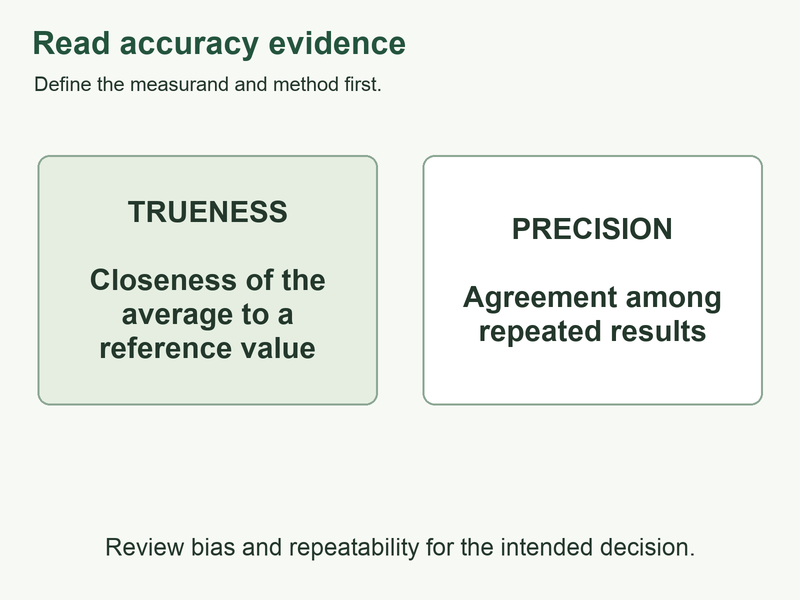
Accuracy reflects closeness of agreement, while trueness concerns systematic agreement and precision concerns dispersion among repeated results. Bias estimates a systematic difference under defined conditions. Strong precision cannot prove trueness.
The VIM states that measurement accuracy is not a quantity assigned a numerical value. That prevents buyers from compressing trueness, precision, and uncertainty into one percentage. Review the actual study or quality-control evidence supporting each claim.
A result can repeat closely because the instrument and workflow are stable while remaining shifted by calibration, recovery, interference, or sample preparation. Conversely, low bias in a small study does not establish routine precision.
Use appropriate reference materials, recovery evidence, or comparison data when assessing systematic effects. Document whether a correction is applied and whether uncertainty in that correction enters the budget. Leaving a known bias uncorrected requires a justified treatment rather than silently calling the remaining result accurate.
Key Takeaway: Read trueness and precision separately; neither one alone establishes accurate routine results.
What are Type A and Type B uncertainty evaluations?
Type A evaluation uses statistical analysis of measured quantity values, while Type B uses other available information. Under the JCGM Guide to the Expression of Uncertainty in Measurement, both produce standard uncertainty components that can enter a combined model; Type B does not mean inferior evidence.
Type A inputs may come from repeatability or intermediate-precision data. Type B inputs may come from calibration certificates, reference-material values, resolution, published information, or prior knowledge, provided their distributions and relevance are justified.
Avoid counting the same effect twice. For example, a precision study may already include day-to-day calibration variation that is also entered separately. The budget owner should map each effect to the model, examine correlation, and state why an input is independent or related.
| Input | Possible evaluation | Review question |
|---|---|---|
| Repeated measurements | Type A statistical evaluation | Does the design represent routine variation? |
| Calibration certificate | Type B information | Is the calibration applicable to this use? |
| Reference material | Type B assigned value | Does matrix and range fit? |
| Instrument resolution | Type B model input | Is the assumed distribution justified? |
| Recovery study | Model-dependent | Is correction or uncertainty treatment explicit? |
Key Takeaway: Type A and Type B describe evaluation routes, not strong and weak categories.
How are combined and expanded uncertainty reported?
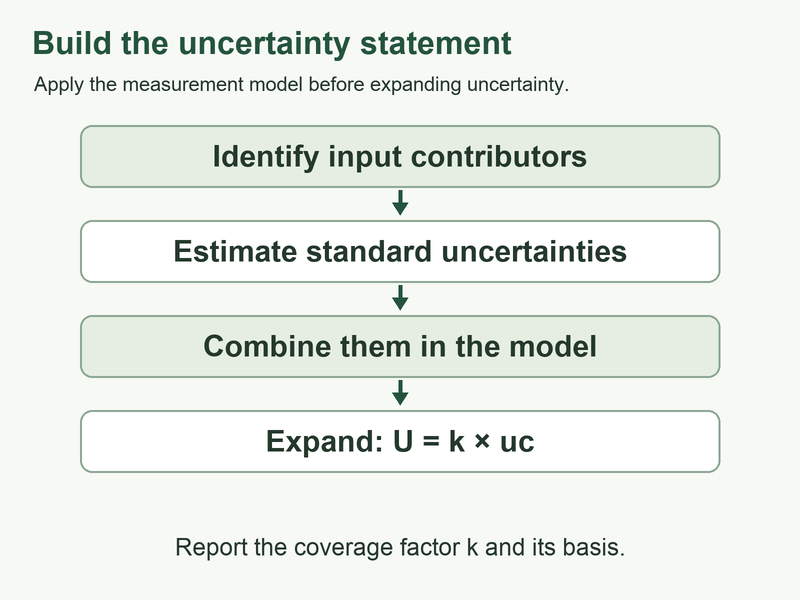
Combined standard uncertainty brings relevant standard uncertainty components together through the measurement model. Expanded uncertainty multiplies the combined standard uncertainty by a coverage factor, commonly written as U = k·uc, with the factor and coverage basis stated.
NIST Technical Note 1297 uses this reporting structure. A bare “±” value is incomplete if the report omits whether it is standard or expanded uncertainty, the coverage factor, and the confidence or coverage interpretation.
Compare intervals only when the measurand, unit, method, and coverage basis align. A smaller number does not automatically mean a better laboratory if scopes or assumptions differ.
Rounding should preserve the relationship between result and uncertainty. Excess decimal places imply resolution the measurement does not support, while coarse rounding can change a borderline conformity decision. The laboratory should apply a controlled rounding convention and show enough digits for the buyer to reproduce the stated rule.
Key Takeaway: Read the uncertainty value with its coverage factor, units, and reporting basis.
What belongs in an uncertainty budget?
An uncertainty budget should identify the measurement model, input quantities, estimates, standard uncertainties, distributions, sensitivity coefficients where applicable, correlations, combined result, coverage factor, and review basis. It should show why contributors were included or excluded.
For a food method, contributors may arise from sample preparation, mass and volume measurements, calibration, recovery, repeatability, intermediate precision, standards, blanks, and environmental effects. The actual list follows the method, not a generic template.
Rank contributors by their effect on the combined result. This helps the laboratory improve the measurement efficiently: reducing a minor balance component will not matter if extraction recovery dominates. It also helps buyers see whether the budget reflects the difficult part of the method or only the easiest quantities to calculate.
The bounded recommendation is to challenge budgets dominated by a convenient repeatability study while ignoring sample preparation or recovery. A neat spreadsheet is not sufficient if its model omits the largest real source of result variation.
Key Takeaway: The budget must represent the whole measurement model, including preparation and matrix effects.
How should uncertainty affect conformity near a specification limit?
Uncertainty should affect conformity through a pre-agreed decision rule that states how the result and uncertainty relate to the specification limit. Without a rule, two reviewers can reach different dispositions from the same report.
A simple pass based only on the reported central value may create false acceptance near a limit. A conservative guard band may reduce that risk but increase false rejection. The choice should reflect regulation, contract, consequence, and agreed risk allocation.
Document who bears the residual risk and what happens to indeterminate or borderline results. Options can include confirmatory analysis, a second method, additional sampling, or hold for technical review, but the route must be agreed before the result arrives. Repeated testing until one value passes is not a decision rule.
| Result position | Decision issue | Required action |
|---|---|---|
| Far inside limit | Uncertainty may not change disposition | Apply documented rule |
| Near limit | Interval may cross boundary | Escalate under agreed rule |
| Far outside limit | Failure is clearer | Confirm identity and controls |
| Rule absent | Reviewer discretion dominates | Hold and define rule before release |
Key Takeaway: Agree the conformity rule before testing so uncertainty is not interpreted opportunistically.
How can buyers compare uncertainty across laboratories?
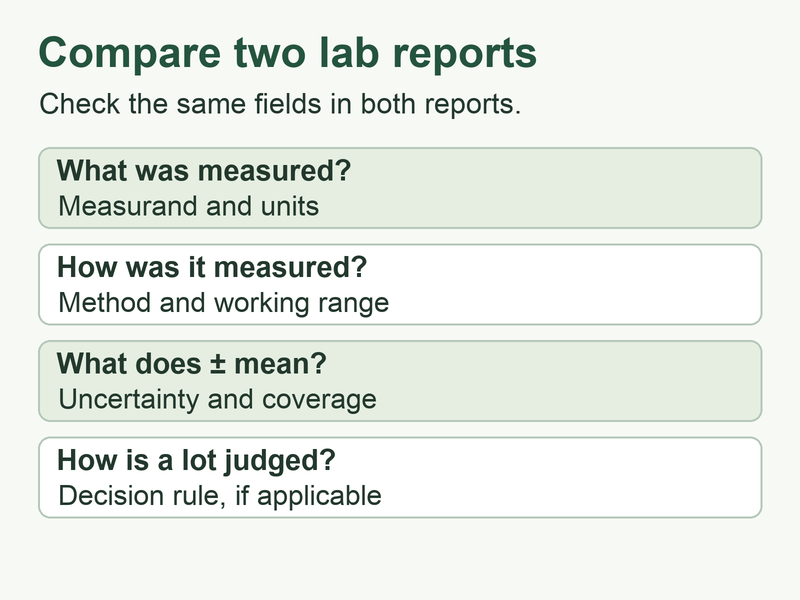
Buyers should compare uncertainty only after aligning measurand, matrix, range, method, units, coverage factor, sample preparation, and intended use. One laboratory’s broad scope may produce a larger honest interval than another laboratory’s narrow or incomplete estimate.
Ask whether the budget is result-specific, range-based, or a fixed capability statement. Check whether bias corrections and recovery are treated consistently. Review the matcha water activity guide for an example of why method and conditions must accompany the number.
Compare the laboratories at the concentration or decision range that matters. Relative uncertainty can grow near a detection or quantitation boundary, so an interval quoted at a high calibration level may not describe a low-level customer result. Ask how the reported budget changes across the range.
Do not award work automatically to the smallest quoted uncertainty. An implausibly small interval can signal omitted contributors or a scope mismatch rather than superior capability.
Key Takeaway: Compare like with like and investigate unusually small uncertainty claims before using them commercially.
What changes require the uncertainty evaluation to be reviewed?
Review the uncertainty evaluation when the method, matrix, range, instrument, calibration, reference material, sample preparation, software, site, analyst workflow, or reporting rule changes. Routine quality-control trends can also show that old inputs no longer represent performance.
Not every change requires rebuilding the budget from zero. Assess which inputs and relationships are affected, update those components, recalculate the result, and document the approval. A matrix expansion may require more than an equipment replacement.
Use routine control data to test whether budget assumptions remain representative. If intermediate precision increases, recovery shifts, or a calibration process changes, the historical component may understate current performance. Define review triggers and an owner so the budget does not remain frozen while the method evolves.
Connect the review to the matcha specification change process. A tighter limit can make an unchanged uncertainty newly important to conformity decisions.
Key Takeaway: Recalculate or confirm uncertainty whenever evidence or decision conditions no longer match the approved model.
What should a buyer review on the laboratory report?
A buyer should review the result, unit, method, measurand, sample identity, uncertainty statement, coverage factor, decision rule, conformity statement, limitations, and laboratory authorization. Ask for a summary of the budget when the result is decision-critical.
Separate uncertainty from accreditation scope, method validation, calibration status, and proficiency evidence. Those controls support competence but do not replace the uncertainty statement for this result.
Check consistency between the numerical result and any text declaration. A certificate may show a value and uncertainty yet state “complies” without identifying the decision rule. Ask the issuer to clarify the rule and scope rather than inferring that every point inside the interval must meet the limit.
The practical choice is to escalate detailed budget review when results approach limits, laboratories disagree, methods change, or the decision has high consequence. Routine results far from a limit may need only the approved reporting format and quality controls.
Retain the reviewed report with the specification revision and lot decision so later investigations can reconstruct exactly which uncertainty and rule supported release.
Key Takeaway: Review uncertainty in the context of the exact result and decision, not as a standalone laboratory score.
FAQ
- Is measurement uncertainty the same as accuracy?
- No. Uncertainty quantifies dispersion attributed to a result, while accuracy describes closeness of agreement with a true or accepted reference value.
- Can a precise method still be inaccurate?
- Yes. Repeated results can cluster closely while remaining systematically biased.
- What does expanded uncertainty mean?
- Expanded uncertainty is combined standard uncertainty multiplied by a stated coverage factor and reported with its coverage basis.
- Are Type B uncertainty inputs less reliable than Type A inputs?
- No. Type A and Type B describe different evaluation methods; both require justified, applicable evidence.
- Does uncertainty automatically change a pass or fail?
- No. The specification, applicable requirements, and pre-agreed conformity decision rule determine how uncertainty affects disposition.
- Should buyers choose the laboratory with the smallest uncertainty?
- Not automatically. First compare measurand, matrix, range, method, units, coverage, and included contributors.
Conclusion
Measurement uncertainty vs accuracy becomes useful when the measurand, interval, coverage, bias evidence, and conformity rule are explicit. Compare laboratories on aligned conditions and revisit the budget when the method, matrix, or limit changes. For matcha specifications and laboratory-document alignment, contact AdoroHu Matcha before setting the release rule.