
An oxygen absorber vs desiccant decision for matcha starts with the failure you must control: oxidation or moisture uptake. Choosing by packet name alone can leave color, aroma, and flow exposed.
Matcha can face both hazards. Start the oxygen absorber vs desiccant comparison with the barrier and seal evidence in our matcha oxygen-barrier guide, then qualify the device against headspace, distribution, and acceptance criteria.
Oxygen absorbers control oxygen, while desiccants control water vapor. A buyer should select either device from the dominant failure mode, then validate its capacity, activation, placement, and compatibility in the finished matcha pack. Neither device can repair a weak seal or an inadequate barrier.
In short:
Key points:
- Diagnose oxidation and moisture risks separately before selecting a packet.
- Size and qualify the device with real headspace, barrier, seal, and climate data.
- Treat combined use as a supplier-supported trial question, not a universal rule.
What is the practical difference between an oxygen absorber and a desiccant?
The practical difference is the package condition each device changes: an oxygen absorber reduces oxygen, while a desiccant adsorbs water vapor. In an oxygen absorber vs desiccant review, that distinction determines the test method, supplier data, and failure criteria.
| Buyer question | Oxygen absorber | Desiccant |
|---|---|---|
| Primary target | Oxygen in the sealed pack | Water vapor and package humidity |
| Typical evidence | Capacity, activation, headspace, residual-oxygen trend | Sorption capacity, humidity conditions, moisture trend |
| Main dependency | Sealed pack, oxygen ingress, activation chemistry | Sealed pack, vapor ingress, material isotherm |
| Cannot prove alone | Microbial safety or shelf life | Product safety or oxidation control |
A dry pack can still contain oxygen, and a low-oxygen pack can still carry damaging moisture. The packet remains one control within a package system.
Key Takeaway: Define the unwanted condition first; then buy the device that measurably controls it.
Which matcha risk should an oxygen absorber or desiccant control first?
Control the failure mode that reaches an unacceptable limit first during the intended shelf life. For matcha, the oxygen absorber vs desiccant choice should follow measured changes in color, aroma, flavor, flow, clumping, moisture, or water activity.
Compare a control pack with candidate treatments under the same fill weight, closure, light, temperature, and humidity. This isolates the packet from film or storage changes.
AdoroHu supplies bulk matcha in sealed food-grade liners and retail matcha in pouches or tins. Those formats create different headspace, reclosure, and distribution conditions, so one active-device specification should not be copied across them without testing. For broader handling context, use the matcha storage guide without turning household practices into a commercial pack specification.
Key Takeaway: Let the earliest product failure, not habit, set the first control target.
How do water activity and headspace affect absorber or desiccant selection?
Moisture content, water activity, headspace humidity, and headspace oxygen answer different questions and should be measured separately. An oxygen absorber vs desiccant trial becomes unreliable when these terms are treated as interchangeable.
Moisture content describes total water. The FDA water-activity technical guide defines water activity as equilibrium relative humidity divided by 100 at a controlled temperature. For example, 40% equilibrium relative humidity corresponds to an illustrative water activity of 0.40; this is a formula example, not a matcha specification or safe value. Headspace humidity measured outside equilibrium and headspace oxygen remain separate package conditions.
Avoid specifying a desiccant from moisture content alone. Without water-activity, caking, and sensory evidence, aggressive drying may solve the wrong problem and create a texture or activation conflict. The operational consequence is a packet that passes incoming inspection but fails the finished-product objective.
Key Takeaway: Measure product water and headspace gases as separate variables before choosing a control.
How should buyers size an absorber or desiccant for the pack?
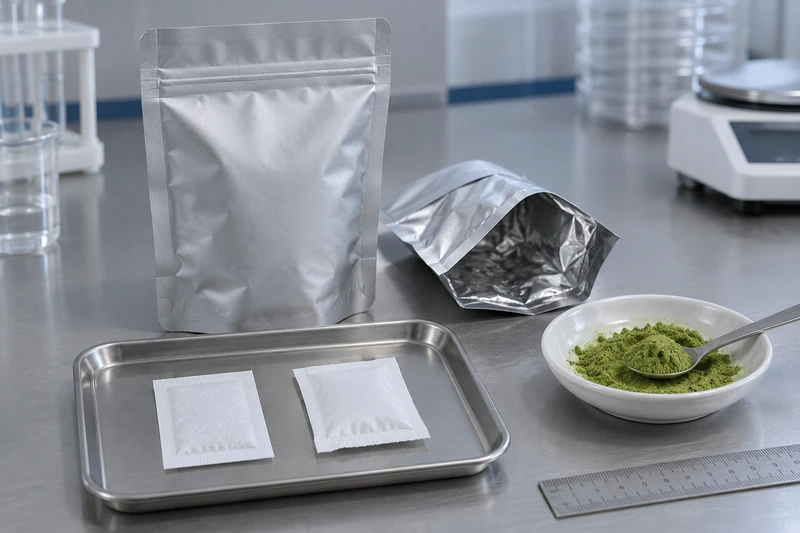
Buyers should size capacity from the total load the device must manage, not from powder weight alone. For an oxygen absorber vs desiccant specification, the load includes initial headspace, product contribution, film ingress, seal performance, and the expected distribution period.
| Input to document | Why it changes capacity | Evidence to request |
|---|---|---|
| Fill weight and pack dimensions | Set free volume and device placement | Approved pack drawing and fill range |
| Headspace at sealing | Sets the initial gas or vapor load | Headspace measurement method |
| Film and closure | Control oxygen or water-vapor ingress | Supplier barrier data at stated conditions |
| Distribution climate | Changes permeation and sorption behavior | Temperature and humidity profile |
| Intended shelf life | Sets the exposure duration | Finished-pack stability protocol |
Manufacturer technical guidance supports selecting and testing an absorber for the actual product, gas volume, film barrier, and package conditions. It does not validate a dose for matcha, so the buyer still needs exact candidate data and a finished-pack trial.
Reject any quote that gives only “one packet per pouch.” Missing capacity assumptions transfer hidden failure risk to the buyer.
Key Takeaway: Approve the calculation inputs and margin with the supplier before approving a device size.
Why do barriers and seals still matter with active packaging?
Barrier film and seals matter because an active device has finite capacity and cannot correct continuous leakage. The oxygen absorber vs desiccant decision must therefore sit downstream of a proven package construction and repeatable sealing process.
OTR and MVTR describe different permeation paths. Seal channels, pinholes, and repeated opening can create loads a capacity claim never covered.
For commercial retail positioning, align device trials with the intended wholesale matcha supply and its actual closure. This prevents a valid device from receiving blame for a pack-format failure.
Key Takeaway: Confirm film, closure, and seal performance before asking a sachet to carry the package system.
How do active-packet chemistry and line handling affect performance?
Activation chemistry and line handling determine when the device starts working and how much useful capacity remains at sealing. In practice, an oxygen absorber vs desiccant comparison must include supplier-defined exposure limits, storage conditions, and resealing procedures.
Some oxygen absorbers use iron oxidation and depend on moisture conditions. Desiccants may use bentonite, silica gel, or molecular sieve, and their response varies with relative humidity. These source-specific mechanisms show why a material name alone is not a performance specification.
Map packet removal from its protective outer pack through insertion and final sealing. Record open time, line stops, partial-bag handling, storage, and lot identity. Otherwise, production exposure can consume performance before the finished pouch is closed.
Key Takeaway: Put the supplier’s activation and exposure instructions into the line work instruction and batch record.
Can a matcha pack use an oxygen absorber and desiccant together?
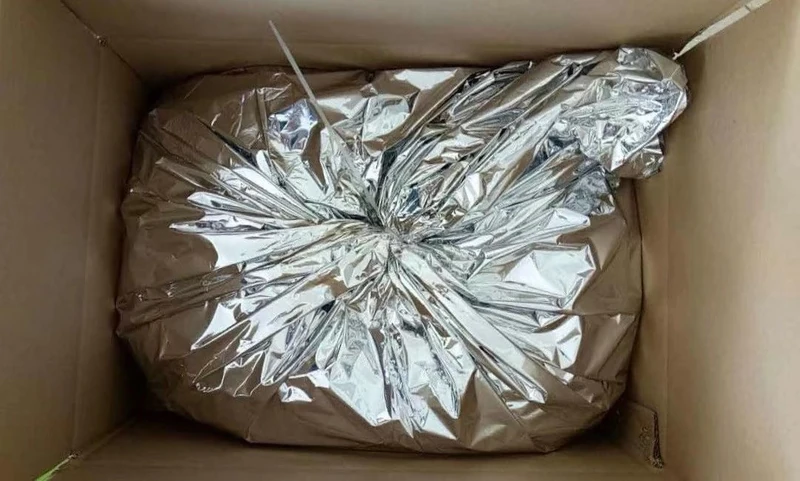
A matcha pack can use both only when the two devices, product, and package have been qualified together. A universal allow-or-ban rule would hide the chemistry and test conditions that control the result.
Some systems may benefit from both controls. Others may fail because drying changes absorber activation or placement limits gas exchange. Ask suppliers to state compatibility, activation, capacity, and placement constraints in writing.
| Trial arm | What it isolates | Minimum review |
|---|---|---|
| No active device | Package baseline | Oxygen, moisture, water activity, sensory change |
| Oxygen absorber only | Oxygen-control effect | Activation and residual-oxygen trend |
| Desiccant only | Moisture-control effect | Humidity, moisture, flow and clumping |
| Both devices | Interaction and added value | All measures plus placement and activation |
Key Takeaway: Combined use is a testable design option, not a default recipe.
Where should active packets sit, and how should ingestion risk be controlled?
Packets should sit where gas or vapor can reach them without contaminating product, blocking seals, or entering the consumer’s serving path. The oxygen absorber vs desiccant placement plan also needs physical retention, clear identification, and documented food-contact suitability.
Do not assume “food grade” covers every market or contact condition. For EU-bound packs, the US government’s EU labeling and marking overview says Regulation (EC) No 450/2009 requires non-edible active or intelligent material parts that consumers may perceive as edible to carry “DO NOT EAT” and, where technically possible, a pictogram. The buyer consequence is a market-scoped artwork proof and opening-design review for the exact packet, not a global warning rule.
For custom retail assembly, capture these constraints in the private-label matcha specification rather than leaving them to a packing-line note. The operational benefit is consistent placement across artwork, tooling, and production instructions.
Key Takeaway: Approve packet identity, contact status, retention, and placement as part of the finished pack.
What active-packaging evidence should procurement and QA request?
Procurement and QA should request evidence for the exact commercial code, not a generic brochure. A defensible oxygen absorber vs desiccant file connects technical capacity, regulatory documentation, traceability, storage, handling, and change control.
Request a specification, performance conditions, activation needs, storage instructions, market-specific food-contact documentation, lot coding, certificate format, and change-notification process.
AdoroHu’s in-house microbiology and physical-chemical laboratories can support product-side measurements within their approved methods. Device performance and package compatibility still require agreed methods, suitable instruments, and supplier evidence; the laboratory fact does not prove a shelf-life result.
Key Takeaway: Make the evidence pack a purchase requirement before the first production lot arrives.
How should an absorber or desiccant trial define acceptance?
A packaging trial should define its endpoints, methods, sampling times, controls, and pass criteria before samples are filled. This turns the oxygen absorber vs desiccant choice into a reviewable qualification rather than a visual packet check.
Track headspace oxygen, moisture or water activity, color, aroma, flavor, flow, clumping, pack integrity, packet condition, and relevant microbiological criteria. The sample count depends on the protocol and risk.
Approve the result only within the tested pack, fill, line, device code, and distribution conditions. A material, supplier, film, closure, fill-volume, or process change should trigger documented impact review and, when relevant, requalification.
Key Takeaway: Release the system against pre-agreed data, and keep every conclusion inside the tested boundary.

FAQ
- Which is better for matcha, an oxygen absorber or a desiccant?
- Neither is automatically better. Choose the device that controls the measured dominant failure mode, then validate it in the finished matcha pack.
- Can an oxygen absorber remove moisture from matcha packaging?
- No. An oxygen absorber targets oxygen; it should not be treated as a desiccant or as proof of moisture control.
- Can a desiccant prevent matcha oxidation?
- A desiccant controls water vapor, not oxygen. It may support a moisture-control objective, but oxidation still requires suitable barrier, seal, and oxygen-control evidence.
- Can oxygen absorbers and desiccants be used in the same pouch?
- They can be evaluated together, but compatibility is not universal. Confirm activation chemistry and placement with suppliers, then compare the combined pack against controlled trial arms.
- How should a buyer choose packet capacity?
- Use real headspace, initial conditions, product contribution, film ingress, seal performance, distribution climate, and intended shelf life. Do not size from powder weight alone.
- What documents should a sorbent supplier provide?
- Request the exact product specification, performance conditions, activation and handling instructions, food-contact documentation, lot traceability, storage life, certificate format, and change-notification policy.
Conclusion
Choose the active device only after the failure mode, pack inputs, and acceptance criteria are clear. Then trial the exact commercial code in the finished matcha package and keep the conclusion inside that validated boundary. Contact AdoroHu Matcha to align matcha format, packaging requirements, and sample planning for your project.