
Colorimeter vs spectrophotometer selection should start with the color decision a matcha buyer needs, then work backward to spectral data, geometry, sample presentation, portability, and transfer requirements. A more capable instrument can still produce weak evidence when the powder fixture and method are uncontrolled.
For matcha procurement, colorimeter vs spectrophotometer choice sits before the acceptance method. The culinary matcha color and consistency guide provides the commercial context; the instrument decision determines which color information can be measured and shared.
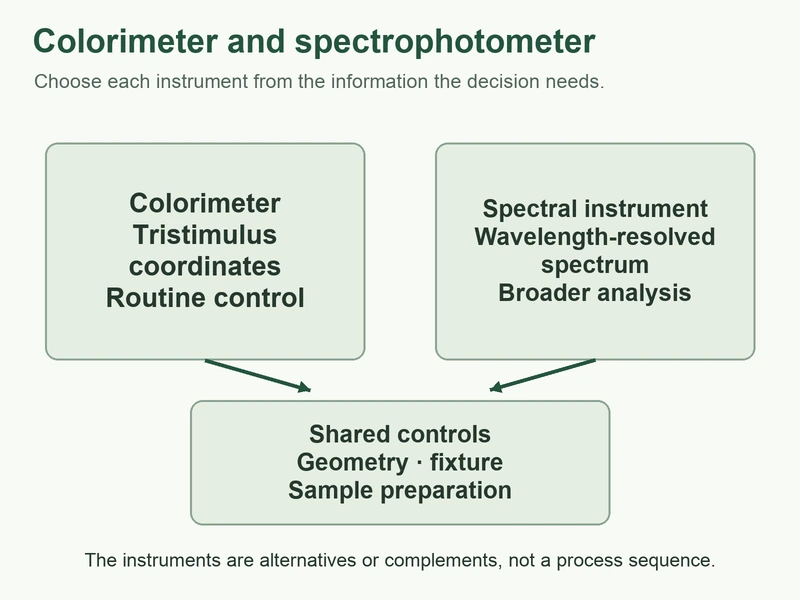
A colorimeter estimates color coordinates through a limited set of filters, while a spectrophotometer measures reflectance across wavelengths. Either can support routine control when its geometry, sample fixture, settings, and decision rule fit the task. Instrument capability does not create a matcha tolerance by itself.
In short:
Key points:
- Choose between tristimulus coordinates and wavelength-resolved spectral data.
- Control geometry, aperture, powder depth, surface, and reference conditions.
- Plan calibration, transfer, and future uses before comparing purchase price.
What is the practical colorimeter vs spectrophotometer difference?
The practical colorimeter vs spectrophotometer difference is the information captured. A colorimeter uses filters designed to approximate standard color-matching responses and reports coordinates such as L, a, and b*. A spectrophotometer measures reflectance or transmittance across wavelength bands, then calculates color values from that spectrum.
Spectral data can be recalculated for supported illuminants and observers and can reveal differences hidden by one coordinate set. The extra information helps with metamerism analysis, formulation, and transfer between materials. A routine pass/fail check may not need that depth when the method and product remain stable.
ASTM E1164 addresses acquiring spectrometric data for object-color evaluation under specified measurement geometry and conditions. That acquisition step is the spectrophotometer’s distinctive evidence base: the instrument retains wavelength-resolved measurements before color coordinates are calculated. A colorimeter instead produces its supported colorimetric outputs from its filter response without retaining the same full spectral record.
Choose the least complex instrument that answers the approved decision with adequate uncertainty. Buying spectral capability without a controlled workflow increases cost and training without guaranteeing better lot decisions.
Define the output before requesting quotations. For routine difference checks, specify color space, equation, illuminant, observer, and reporting resolution. For spectral work, define wavelength range, interval, export format, and software access. This prevents a feature comparison from replacing the measurement requirement.
Build a user requirement specification with representative samples and expected actions. Include the darkest and lightest grades, the smallest available sample quantity, required throughput, cleaning restrictions, operator skill, and data-system constraints. Ask vendors to demonstrate the complete workflow with those materials. A brochure comparison can omit fixture handling or software steps that determine whether the instrument works in daily receiving.
Key Takeaway: Select the data type from the decision, not from the assumption that more wavelengths are always better.
How do ASTM and CIE frameworks affect instrument choice?
ASTM and CIE frameworks affect instrument choice by defining how spectral measurements become reported color values. ASTM E308 addresses calculation of object-color coordinates from spectral data using defined illuminant and observer conditions. The calculation configuration determines which tristimulus or derived values the same stored spectrum produces.
CIE colorimetry provides standard observer and illuminant frameworks used for reporting. These sources support comparable language, but none supplies a matcha-specific geometry, cup, compaction method, or tolerance. The buyer and laboratory must establish those method details.
Record the standard edition, instrument mode, illuminant, observer, color space, and difference equation. Without them, identical labels such as “Lab*” can conceal calculation differences.
A claim that an instrument “follows CIE” does not identify the applied conditions. The method owner should retain the licensed standard, translate relevant requirements into the procedure, and review revisions before changing the setup. Buyers can then compare named conditions instead of accepting a broad standards claim.
Key Takeaway: Standards organize measurement and reporting; the matcha method still needs an approved sample and instrument setup.
Why does measurement geometry matter for matcha powder?
Measurement geometry matters because it controls how illumination reaches the powder and which reflected light reaches the detector. Directional and diffuse geometries respond differently to gloss, texture, shadows, and surface variation. Specular-included and specular-excluded modes also answer different appearance questions.
ASTM E1164 requires the spectrometric acquisition conditions and geometry to be specified. This makes geometry part of the result, not an interchangeable instrument setting. A transfer between directional and diffuse instruments therefore needs evidence; agreement cannot be assumed from matching color-space labels.
Matcha is a particulate, scattering material rather than a flat opaque tile. Particle distribution, packing, surface leveling, cup depth, and stray light can change the signal. The same instrument may produce different results with another aperture or fixture even when the powder has not changed.
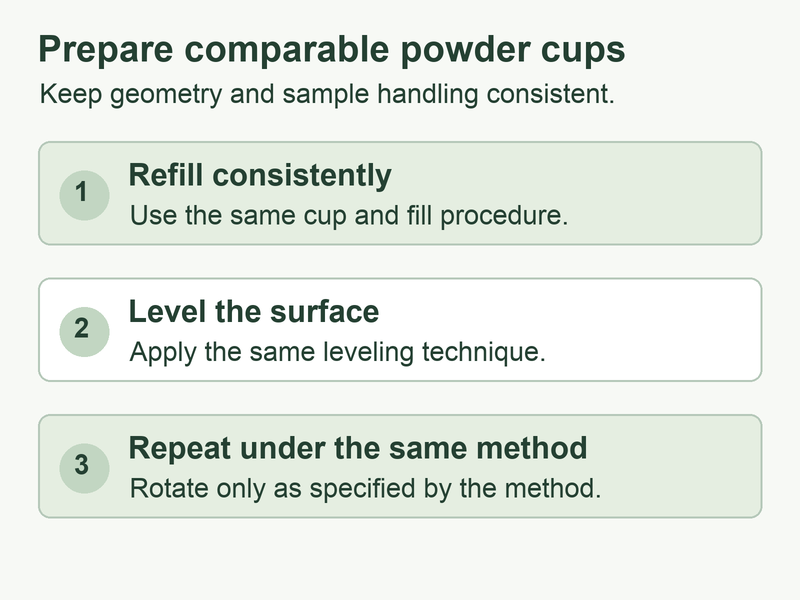
Test geometry with representative light, dark, coarse, and fine samples. Rotate and refill the cup to quantify presentation variation. A small spot may amplify local surface differences; a larger aperture averages more material but requires sufficient depth and a fixture that prevents edge leakage.
| Geometry decision | What it changes | Record needed |
|---|---|---|
| Directional or diffuse | Sensitivity to texture and scattering | Instrument geometry |
| Specular setting | Treatment of surface reflection | Included or excluded mode |
| Aperture | Area averaged and edge risk | Aperture size |
| Cup and depth | Background and optical path | Fixture and fill procedure |
Key Takeaway: Match geometry and fixture to the powder presentation, then keep them fixed across comparison lots.
When is a colorimeter enough for routine quality control?
A colorimeter is enough when the task is a stable, validated coordinate or color-difference check on one product family under fixed conditions. It can support rapid receiving or production screening when users need clear coordinates and an approved threshold rather than spectral diagnosis.
The method should show repeatability across preparation repeats, days, and trained operators. It also needs a reference artifact or control sample, calibration rules, and a response to drift. A low-cost device without this system can create precise-looking numbers that do not transfer.
Use a guard band when measurement variation matters near the limit. Borderline samples can move to additional preparation repeats or a confirmatory method rather than being forced into pass or fail. This preserves routine speed without overstating certainty at the decision boundary.
Prefer a colorimeter for a bounded routine task when spectral data will not change action. The consequence is lower cost and simpler training, provided future formulation and multi-illuminant needs are unlikely.
Key Takeaway: Use a colorimeter for a controlled, repetitive coordinate-based decision whose limits have been demonstrated.
When does a spectrophotometer add decision value?
A spectrophotometer adds value when wavelength-resolved reflectance supports formulation, root-cause work, metamerism analysis, illuminant changes, or transfer across product and packaging applications. The spectrum retains information that a few filtered channels cannot reconstruct.
This capability helps when two samples match under one viewing condition but separate under another, or when the buyer wants to understand where reflectance changed. It can also support future calculations without repeating the physical measurement, if the stored spectrum and metadata remain valid.
Store the spectrum with sample identity, instrument, geometry, calibration status, software version, and preparation record. A screenshot cannot support later recalculation. Confirm export formats and whether software updates change calculations before treating the spectral archive as reusable evidence.
Do not equate spectral capability with universal accuracy. Instrument quality, wavelength interval, geometry, stray light, fixture, and sample variability still determine usable results.
Key Takeaway: Choose spectral measurement when wavelength information will change formulation, diagnosis, illumination, or future analysis.
How should matcha samples be prepared for color measurement?
Matcha samples should be conditioned, filled, leveled, and measured with a written procedure that limits particle and surface effects. Define sample mixing, temperature or equilibration where relevant, cup identity, fill mass or depth, compaction, leveling, rotation, and replicate positions.
Avoid pressing one sample firmly and leaving another loose. Compaction changes density, shadowing, and surface texture. Protect the optical window from powder while ensuring the fixture does not introduce a colored background or variable gap.
Condition samples consistently after opening because moisture, temperature, and settling can affect presentation. State when the sample is mixed, how the cup is refilled, and whether repeated measurement changes the surface. Transfer between sites needs the same handling rules.
| Preparation factor | Controlled action | Failure consequence |
|---|---|---|
| Homogenization | Mix without changing the powder | Local variation drives result |
| Fill depth | Exceed validated optical depth | Background influences reading |
| Surface | Use defined leveling or compaction | Texture changes reflection |
| Replicates | Rotate and refill as specified | One surface becomes the lot result |
The matcha particle-size specification guide explains a related material property, but particle size and instrumental color remain separate specifications.
Key Takeaway: Standardize powder preparation before comparing instruments or establishing tolerances.
How should buyers compare repeatability and instrument agreement?
Buyers should compare repeatability within each instrument before comparing instruments with each other. Measure independently prepared replicates, not repeated triggers on the same untouched surface. Then test days, operators, and representative colors across the intended range.
Inter-instrument agreement is a separate question. Two devices may each repeat well but differ because of geometry, bandwidth, calibration, or data processing. A transfer study needs paired samples, predefined acceptance criteria, and a decision for bias or model-specific limits.
Use samples spanning the commercial color range. Examine constant bias, color-dependent bias, and replicate spread. If a correction equation is proposed, reserve independent samples to test it and control the software version so the fitted transfer does not silently fail future grades.
Define what happens when transfer fails. Options include keeping model-specific limits, routing measurements to one reference instrument, recalibrating the transfer, or rejecting the secondary device for release decisions. Do not adjust a product tolerance merely to hide instrument disagreement. The record should show whether the difference comes from device bias, geometry mismatch, sample preparation, or unstable material.
NIST Chapter 10 on color and appearance discusses spectral and tristimulus color measurement together with measurement and viewing geometry. It supports recording the measurement model and geometry when comparing instruments, but it does not set a matcha product tolerance.
Key Takeaway: Establish repeatability first, then quantify model-to-model agreement across representative matcha samples.
What should calibration and reference control include?
Calibration and reference control should include manufacturer procedures, clean and undamaged reference tiles, environmental limits, check frequency, acceptance criteria, and action after failure. Calibration establishes the instrument response; a control sample can reveal method drift involving the fixture or preparation.
Protect reference artifacts from contamination, abrasion, and unauthorized cleaning. Record identity and due status. If a check fails, bound results since the last acceptable check rather than recalibrating and silently continuing.
Separate session verification from external calibration or service. A white-tile check cannot assess every optical or wavelength fault. Define who may adjust the instrument, which results are invalidated, and whether retained samples must be remeasured after repair.
| Control layer | Purpose | Failure action |
|---|---|---|
| Instrument calibration | Set response against reference | Stop and restore status |
| Verification tile | Detect drift after calibration | Investigate instrument condition |
| Powder control | Detect fixture or preparation shift | Review sample workflow |
| Trend chart | Reveal gradual movement | Investigate before limit breach |
Key Takeaway: Control the instrument and the powder method separately so drift can be located and affected results bounded.
How should cost, portability, and future use be weighed?
Cost, portability, and future use should be weighed against the complete measurement lifecycle. Purchase price excludes fixtures, standards, software, calibration service, training, method development, data export, maintenance, and replacement availability.
Portable instruments can improve receiving or supplier visits but introduce ambient, positioning, and handling challenges. Bench instruments may offer better fixtures and workflow control. Neither form factor is inherently superior for matcha.
Evaluate throughput across conditioning, filling, replicates, cleaning, review, and data transfer. Check service coverage, reference replacement, software licensing, export controls, and product life. Those costs determine whether the method remains usable after procurement.
Include data integrity in the purchase decision. Require user roles, protected methods, audit history where needed, reliable sample identifiers, backup, and export in a durable format. Manual transcription can be acceptable for low volume if independently checked, but a high-throughput workflow needs controls that prevent results being attached to the wrong lot.
Choose a portable colorimeter when fast screening at several locations is the stable need. Choose a bench spectrophotometer when controlled spectral analysis and future formulation work justify the infrastructure. Document the tradeoff so later buyers do not compare prices alone.
Key Takeaway: Compare total workflow cost and future decisions, not the instrument purchase price in isolation.
What evidence should approve a color instrument for matcha?
Approval should include intended use, product range, instrument identity, geometry, aperture, settings, preparation method, repeatability, transfer evidence, calibration controls, training, data handling, and decision rules. The package should state what remains unsupported.
Keep instrument selection separate from the matcha color specification. The matcha specification-change guide helps manage later limits or method revisions, while a supplier audit can confirm governance without inventing color performance.
Buyers sourcing wholesale matcha should approve an instrument-method combination, not a model name. A future product or fixture requires review before inheriting that approval.
AdoroHu Matcha’s approved range identifies Ceremonial, Premium, Culinary, and Organic matcha. Those commercial grade identities define which product families the buyer may include in an instrument study, but the instrument does not assign or authenticate a grade. Approval should list the tested grade series and color range so evidence from one family is not silently extended to all four.
State change triggers such as a new model, repaired optics, changed geometry, revised software, new cup, altered preparation, or another grade. Require a bounded comparability study before transferring limits so the existing specification does not absorb silent method drift.
Key Takeaway: Approve the instrument only with the method, scope, performance evidence, controls, and decision rule attached.
FAQ
- Is a spectrophotometer always more accurate than a colorimeter?
- No. Usable accuracy depends on the task, instrument, geometry, sample preparation, calibration, and decision rule.
- Can a colorimeter measure matcha L, a, and b* values?
- Yes, when the instrument and controlled method support those coordinates for the intended task.
- Why measure a full reflectance spectrum?
- Spectral data can support metamerism analysis, formulation, diagnosis, and recalculation under supported conditions.
- Can two color instruments give different results?
- Yes. Geometry, aperture, calibration, bandwidth, processing, and sample presentation can create systematic differences.
- Does a standard provide matcha color tolerances?
- No. Standards support measurement frameworks; buyers still need product-specific methods and acceptance rules.
- What should be validated first?
- Validate powder preparation and within-instrument repeatability before studying transfer between instruments.
Conclusion
The next decision is whether the buyer needs fast coordinate screening or spectral information that supports broader analysis. Approve geometry, fixture, preparation, calibration, and transfer evidence with the instrument. Contact AdoroHu Matcha to align the measurement task with a specific matcha grade and application.