
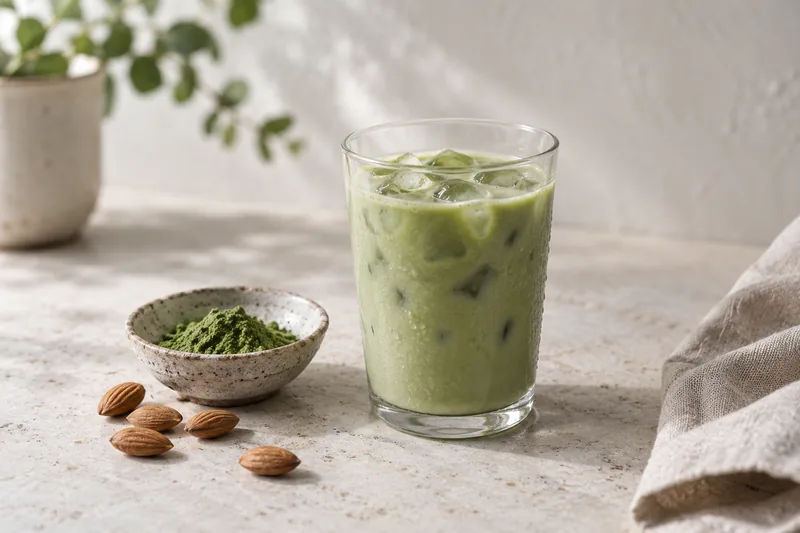
Matcha almond milk works commercially when the team treats the almond base, matcha dispersion, sweetness, and service method as one system. A home recipe can tolerate brand-to-brand variation; a café or beverage line cannot. The wrong base can mute aroma, expose bitterness, or leave a green sediment ring that customers read as poor quality.
Start matcha almond milk development with a controlled formula rather than copying a consumer latte. The existing matcha powder for lattes guide helps narrow the powder style, while this guide focuses on what happens after matcha meets an almond beverage.
A reliable matcha almond milk formula begins with a fixed almond base and a separately dispersed matcha concentrate. Compare sweetness, body, foam, sediment, and color under the intended hot or cold service conditions before choosing the dose.
In short:
Key points:
- Lock the almond beverage specification before adjusting matcha.
- Test hot and iced service as separate formulas.
- Approve the formula from measured trials, not color alone.
What should a commercial matcha almond milk brief define first?
The brief should define the finished drink before the team chooses a powder or sweetener. Record the serving size, hot or iced format, target sweetness, foam requirement, preparation time, and acceptable sediment. Matcha almond milk developed for a made-to-order café cup has a different operating window from a bottled drink.
A useful brief also identifies the exact almond beverage, including whether it is barista-style, sweetened, fortified, or stabilized. These details affect viscosity, flavor release, and foam. If the base changes during development, restart the comparison rather than carrying the old matcha dose forward.
| Brief field | Decision to record | Why it changes the formula |
|---|---|---|
| Service format | Hot, iced, or packaged | Changes dilution, temperature, and hold time |
| Almond base | Exact SKU and lot | Controls solids, sweetness, and stabilizer system |
| Sensory target | Tea-forward, balanced, or dessert-like | Sets the useful matcha and sugar range |
| Operational limit | Preparation and hold time | Determines dispersion and remix needs |
Key Takeaway: Freeze the drink brief and almond base before optimizing matcha.
How should buyers compare almond beverages for matcha?
Buyers should compare almond beverages in a matched formula, changing only the base. Use the same matcha lot, water, sweetener, temperature, mixing sequence, and serving time. This isolates the effect of almond solids, added oils, gums, salt, and flavoring.
Evaluate the drink immediately and again at the end of its realistic service window. A base that tastes clean at minute one may form a ring, lose foam, or develop a thin finish later. For a useful adjacent comparison, review how base composition changes the outcome in commercial matcha coconut milk formulation.
Key Takeaway: Compare bases with one fixed formula and at least two observation times.
What matcha grade works best in an almond beverage?
The best grade is the one that reaches the sensory target at a practical use level. Almond aroma and added flavor can hide delicate notes, so the most expensive grade does not automatically produce the best finished drink. Screen at least two candidate grades in the same base.
AdoroHu’s grade ladder identifies E-3/E-4 as conventional Premium and O-3 as Organic Premium. These codes create a repeatable sample request, but the finished beverage trial still decides suitability. Use a premium matcha powder as the commercial starting point when the brief calls for visible green color and a clear tea finish. Compare actual samples because grade names are not standardized across suppliers. Reject a candidate that needs excessive sweetness to cover harshness or excessive dose to remain recognizable.
| Candidate outcome | Buyer interpretation | Next action |
|---|---|---|
| Clean tea finish at moderate dose | Good application fit | Continue process trials |
| Bright color but weak aroma | Visual fit only | Test another grade |
| Strong bitterness at target dose | Poor balance | Lower dose or change grade |
| Good flavor but rapid settling | Process problem | Adjust dispersion before changing grade |
Key Takeaway: Buy for finished-drink performance, not the supplier’s grade label.
How should matcha be dispersed before almond milk is added?
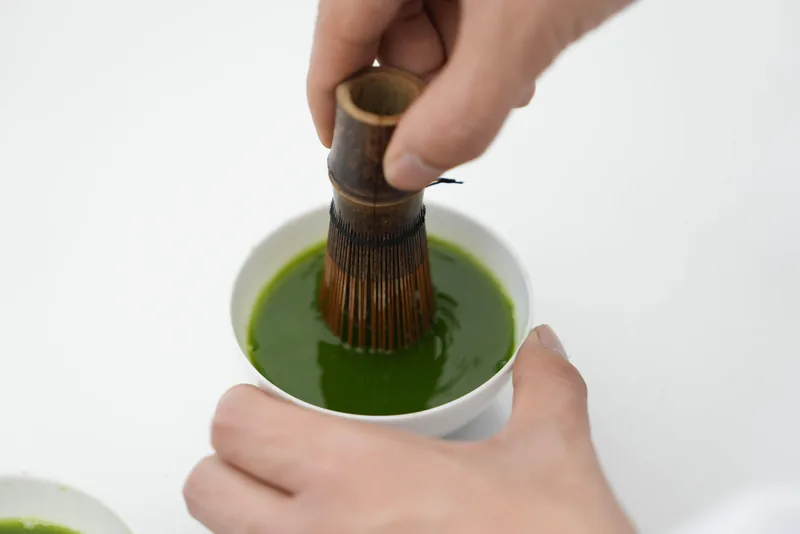
Matcha should be dispersed in a controlled liquid phase before the full almond base is added. Sifting removes dry agglomerates, while a small concentrate gives the mixer enough shear to wet the powder. Dumping dry matcha into a full cold batch often leaves floating islands and hidden clumps.
AdoroHu uses ultrasonic screening and multiple milling routes, including 20 stone mills, 56 ball mills, and 8 continuous ball mills. Confirm that comparison lots follow the agreed process and specification; powder consistency supports, but does not replace, beverage validation. Keep the concentrate ratio, water temperature, mixing tool, and mixing time constant during trials. The matcha solubility testing guide explains why disappearance from view is not true dissolution. Matcha remains a suspension, so the operational goal is uniform dispersion and acceptable settling.
Key Takeaway: Standardize the concentrate step before adjusting stabilizers or dose.
How do sweetness and almond flavor change matcha perception?
Sweetness can reduce perceived bitterness, but it can also flatten the tea finish and turn the drink into a generic sweet latte. Almond flavoring, vanilla, salt, and emulsified oils further change aroma and mouthfeel. Test sweetener as a defined variable rather than adding it until the sample tastes pleasant.
Run a short ladder around the intended sweetness level and blind the samples. Choose the lowest sweetness that delivers the target balance. This is usually safer than selecting the sweetest sample, which can raise ingredient cost and conceal lot-to-lot changes.
Key Takeaway: Use a sweetness ladder and choose the lowest level that protects the tea profile.
How should hot and iced matcha almond milk trials differ?
Hot and iced versions need separate approval because heat, ice dilution, and foam change the drink. For hot service, track heating temperature, foam texture, cooked notes, and color after service. For iced service, fix ice mass and record dilution, sediment, and ring formation.
Avoid approving one concentrate for both formats without a side-by-side check. A stronger concentrate may survive ice dilution but taste rough in a hot cup. Conversely, a hot formula may disappear after melting ice expands the liquid volume.
| Check | Hot service | Iced service |
|---|---|---|
| Primary risk | Heat damage and weak foam | Dilution and settling |
| Record | Temperature and foam drainage | Ice mass and final volume |
| Recheck | End of serving window | After expected ice melt |
Key Takeaway: Treat hot and iced drinks as related products with separate limits.
What should the team measure during a matcha almond milk trial?
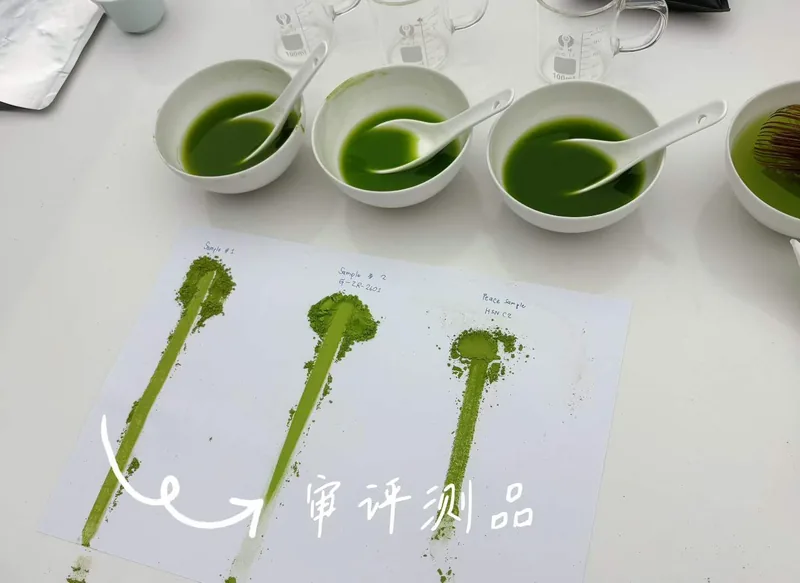
AdoroHu’s in-house microbiology and physical-chemical laboratories can support lot-linked powder COA inputs. The buyer must still validate the finished almond drink. The team should measure variables that support a go, adjust, or stop decision. At minimum, record ingredient weights, finished mass, mixing conditions, pH, visual color under fixed lighting, foam height where relevant, and sediment after defined times. Sensory notes should use the same small vocabulary across panelists.
Measurements do not need to be elaborate, but they must be repeatable. A phone photo can document change only when lighting, distance, vessel, and background remain fixed. A viscosity reading is useful only when the instrument, spindle, temperature, and timing are recorded.
Key Takeaway: Record enough process detail for another operator to reproduce the sample.
When does an almond-milk stabilizer help or hurt?
A stabilizer helps when the base lacks enough structure to slow visible settling or maintain the intended mouthfeel. It hurts when it creates gumminess, suppresses aroma, or adds a label ingredient without solving the actual problem. Check dispersion and base selection before adding more hydrocolloid.
The practical tradeoff is clear: a small stabilizer adjustment can widen the service window, but it also changes flow and foam. Choose it only after a no-change control proves the benefit. For made-to-order service, a remix instruction may be cheaper and cleaner than a formulation change.
Key Takeaway: Require a measured benefit before adding or increasing stabilizer.
How should allergen and cross-contact controls enter development?
Almond is a tree nut, so the ingredient identity and label path belong in the development brief from the start. The FDA lists tree nuts among the nine major food allergens and requires the specific type of tree nut to be declared for packaged foods. Its food allergen guidance page also explains that advisory statements do not replace good manufacturing controls.
For U.S. manufacturing, 21 CFR 117.80 requires precautions against allergen cross-contact and contamination during processing. That means the trial record should identify shared equipment, cleaning controls, rework rules, and label review before commercial approval.
Key Takeaway: Build almond identity, cross-contact, and label review into the formula approval.
What evidence should release a matcha almond milk formula?
AdoroHu’s 10 kg and 20 kg formats use sealed food-grade liners. Pack size affects opening frequency, use rate, and post-opening storage. Release the formula when repeated trials meet written sensory, physical, operational, and compliance limits. A useful approval packet includes the locked formula, ingredient specifications, batch sheet, process settings, observation times, deviations, label review, and named approvers.
Do not turn a kitchen success into a shelf-life claim. Packaged products require representative stability and food-safety work under the intended process and distribution conditions. For a made-to-order drink, approve the service window and operator instructions that the café can actually follow.
Key Takeaway: Approve a reproducible operating window, not one attractive cup.
FAQ
- Does almond milk go well with matcha?
- Yes. Almond milk can support matcha when its nut aroma, sweetness, and body are balanced against the tea dose in a matched trial.
- Should matcha almond milk use sweetened or unsweetened almond milk?
- Start with unsweetened almond milk when possible because it lets the team set sweetness independently and compare matcha grades more clearly.
- Why does matcha settle in almond milk?
- Matcha is a fine suspension rather than a dissolved ingredient, so settling depends on particle dispersion, base viscosity, hold time, and remix conditions.
- Can one formula serve both hot and iced drinks?
- It can, but approve each format separately because heating, foam, ice dilution, and service time change the finished result.
- What should buyers request with a matcha sample?
- Request the current specification, lot-linked quality documents, storage instructions, and enough sample for matched application trials.
Conclusion
A commercial matcha almond milk formula needs a locked base, controlled dispersion, separate hot and iced checks, and a written approval window. AdoroHu Matcha can review the application, target profile, and trial volume through the contact page.