
Matcha nutrition facts cannot be copied safely from a generic website because the correct values depend on the actual product, serving basis, formula and data source. A consumer may want calories, carbohydrate, protein or caffeine at a glance. A private-label brand needs a traceable record that connects each declared value to its own SKU.
This guide answers the lookup honestly, then shows how to construct U.S. label data without inventing numbers. Pure matcha powder, a sweetened matcha mix and a prepared latte are different foods. Their panels should not share values merely because every product name contains “matcha.” For a separate ingredient-level discussion, see our published guide on whether matcha contains caffeine.
The nutrition facts for a specific matcha product must come from that product's documented label basis. Define the SKU and serving first, retain unrounded source data, then apply FDA calculation and rounding rules. If the evidence does not establish a value, leave it unresolved until analysis or a justified calculation closes the gap.
In short: identify the exact SKU and serving, preserve unrounded evidence, then apply the U.S. display and claim rules.
Key points:
- Identify whether the labeled food is pure powder, a formulated mix or a prepared beverage before choosing a serving basis.
- Support unrounded values with SKU-appropriate laboratory, ingredient-database or recipe-calculation evidence.
- Review Nutrition Facts, ingredients, allergens and front-of-pack claims as one approval package.
What can consumers learn from matcha nutrition facts online?
Online matcha nutrition facts can show the types of information people look for, but they do not establish the numbers for an untested SKU. Search results mix plain powder, café drinks, lattes, sweetened blends and database entries expressed per 100 g. Those bases answer different questions.
A consumer comparing products should start with the label on the purchased package. Check serving size, servings per container and ingredient list before comparing calories or sugar. A prepared drink can obtain most of its energy and added sugars from milk, syrup or a premix rather than from the matcha ingredient.
For a brand owner, competitor labels are market observations. They are not source data. Copying a similar-looking product can carry over another company's serving, recipe, supplier assumptions and rounding choices.
Key Takeaway: Use online values to frame questions; use the actual SKU record to approve label numbers.
Which product identity determines matcha powder nutrition facts?
The product identity determines whether matcha Nutrition Facts describe powder as packaged, a dry mix, or a prepared beverage. Under 21 CFR Part 101, section 101.9(b)(9) generally bases nutrient declarations on the food as packaged or purchased, subject to its exceptions and permitted additional presentations.
Write a one-sentence identity before doing any nutrient calculation. Include the formula state, package configuration and promoted use. “Unsweetened matcha powder in a pouch” creates a different decision path from “sweetened powdered drink mix that makes a 12 fl oz beverage.”
The wholesale matcha powder page is a relevant product starting point for source-identity discussion. It supplies no Nutrition Facts values for an unspecified private-label SKU; the finished product still needs its own serving and evidence record.
| Product presented for sale | Evidence question | Common labeling risk |
|---|---|---|
| Single-ingredient matcha powder | Which category and serving procedure apply to this exact presentation? | Borrowing a beverage serving basis without analysis |
| Sweetened or flavored dry mix | What amount makes the prepared reference quantity? | Omitting sugar or carrier ingredients from the calculation |
| Ready-to-drink matcha beverage | What is in the finished container and what is the package size? | Reusing dry-powder values for the finished drink |
| Café latte recipe | Is it a packaged retail SKU or menu item under a different framework? | Treating a café recipe as a packaged-food panel |
Stop the panel when the product identity is vague. Choosing numbers first creates rework across serving size, ingredient order, added sugars and claims once the final SKU is defined.
Key Takeaway: Freeze the exact product identity and presentation before selecting any Nutrition Facts values.
How should a brand set serving size for matcha nutrition facts?
A brand should determine serving size from the applicable reference amount customarily consumed, or RACC, and the conversion procedures in sections 101.9(b) and 101.12. The current section 101.12(b) table lists 360 mL prepared for flavored and sweetened coffee or tea. It also lists the amount needed to make 360 mL for other powdered drink mixes.
Those entries should not be assigned automatically to unsweetened matcha powder. The table contains multiple categories, and FDA category guidance is non-exhaustive. Product identity, customary use, promoted use and package form all affect the analysis.
After choosing the category, convert the reference amount into the appropriate household measure and metric quantity. Keep the weighed amount behind that household measure in the approval file. A teaspoon can vary with powder density and handling, so the label team needs a defensible gram equivalent rather than a casual kitchen scoop.
Key Takeaway: Document the category rationale and serving conversion; do not choose a familiar spoon amount and work backward.
Should matcha label values come from laboratory analysis or a database?
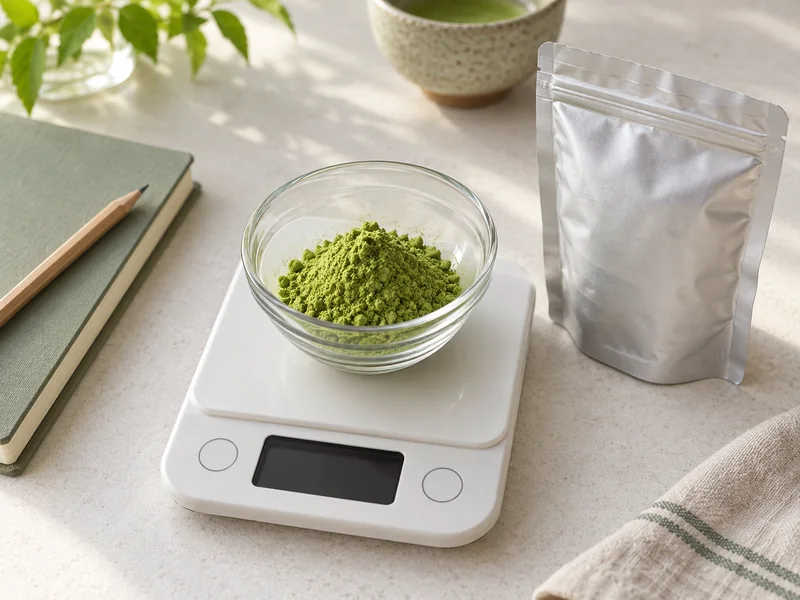
Matcha label values may use laboratory analysis, a suitable database, recipe calculation or a justified combination, but the manufacturer remains responsible for validity. FDA's Guide for Developing and Using Data Bases for Nutrition Labeling says the data source is the manufacturer's choice while recommending product-composition analysis for nutrient values.
Laboratory analysis is strongest when the finished SKU, ingredient variability or processing makes database matching uncertain. Recipe calculation can be efficient for a stable formulated product when every ingredient record, amount, yield and processing adjustment is documented. A hybrid may use finished-product testing for decision-sensitive nutrients and calculations for other values.
| Data route | Best fit | Required controls |
|---|---|---|
| Finished-product laboratory analysis | Variable raw material, novel formula or high-stakes declaration | Sampling plan, representative lots, suitable methods and serving conversion |
| Ingredient/recipe database | Stable documented formula with appropriate source matches | Ingredient identity, supplier data, yield and processing-loss assumptions |
| Hybrid | Formula calculation needs targeted confirmation | Written rule for which values are tested and which are calculated |
USDA FoodData Central is an official nutrient-data system, but a generic entry is not automatically an AdoroHu result. Record the exact food identity, data type and retrieval basis when it is used. No FoodData Central row in this article is adopted as an actual AdoroHu value.
Key Takeaway: Choose the evidence route nutrient by nutrient and preserve why each source represents the finished SKU.
How should matcha nutrition label data handle lot variability?
Brands should handle variability with unrounded source values, representative sampling and a documented calculation method before applying FDA rounding. Matcha is an agricultural ingredient, and a formula can also vary through suppliers, moisture, fill weight and processing yield.
FDA's database guidance describes characterizing the product, designing a sampling plan, collecting sample units, selecting analytical methods and evaluating data statistically. It also recommends carrying decimal precision through the calculation and rounding only at the final stage. A single convenient certificate value should not silently become the lifetime label value for every lot.
Retain the unrounded worksheet as the controlled record and generate the display panel from it. If teams type rounded label numbers back into future calculations, small errors accumulate and claim checks can be made against the wrong value.
The supplier file should also connect the approved ingredient to its specification and lot documentation. Our published matcha specification-sheet guide explains that procurement layer; it does not replace finished-SKU nutrition substantiation.
Key Takeaway: Model real variability using unrounded data, then round once for the final display.
Which nutrients belong on a U.S. matcha Nutrition Facts panel?
The required U.S. panel content and order come from 21 CFR 101.9, with different provisions for exemptions, simplified formats and particular products. The working sheet should therefore map every required declaration to its source value, serving conversion, unit, percent Daily Value treatment and final rounding rule.
Do not insert caffeine, catechins or L-theanine into the Nutrition Facts box merely because consumers search for them. Section 101.9 controls which nutrients and food components may appear in that box. Optional statements elsewhere on the label need their own truthful, non-misleading substantiation and legal review.
A private-label approval table should include at least:
- The mandatory nutrient name and unrounded amount per serving.
- The source record, method or calculation for that amount.
- The applicable Daily Value and percentage calculation where required.
- The FDA rounding rule and final displayed value.
- Reviewer, formula revision, date and approved artwork version.
Key Takeaway: Build the panel from a controlled nutrient map rather than selecting fields from a design template.
Why can a matcha label show zero without supporting a zero-calorie claim?
A matcha label can display zero calories under a rounding rule while still lacking support for a “zero calorie” claim. Section 101.9(c)(1) permits calories below 5 per serving to be expressed as zero and specifies 5-calorie increments through 50 calories, then 10-calorie increments above 50.
The claim standard is separate. Under section 101.60(b)(1), calorie-free and zero-calorie claims require less than 5 calories per RACC and per labeled serving, with the disclosure condition in section 101.60(b)(1)(ii) when the food naturally meets the criterion. The underlying unrounded value and both required bases must pass.
The same discipline applies to other nutrient claims. A displayed zero created by rounding does not erase the measured or calculated amount. It also does not prove that a “free,” “low” or “good source” claim meets its own regulation.
Key Takeaway: Test claims against their claim regulation and unrounded evidence, not against the printed numeral alone.
How should sugar, calories and caffeine be separated across matcha products?
Sugar, calories and caffeine should be separated by product and data source rather than treated as universal matcha facts. Pure powder, a sweetened premix and a latte with milk or syrup have different formulas. Even two pure matcha lots should not be assumed to have identical analytical values.
For sugar and calories, calculate the finished serving and keep every contributing ingredient visible in the worksheet. For caffeine, use an appropriate SKU-specific analytical or otherwise substantiated source if the brand chooses to state an amount. This article supplies no AdoroHu caffeine value and makes no health, weight-loss or cortisol claim.
| Consumer question | Defensible brand response | Evidence needed |
|---|---|---|
| “How many calories are in matcha?” | Identify the exact SKU and serving before giving a value | Approved Nutrition Facts basis |
| “Does matcha contain sugar?” | Distinguish plain powder from sweetened mix and prepared drink | Formula, ingredient statements and nutrient calculation |
| “How much caffeine is in matcha?” | Give a value only for the represented product and serving | SKU-appropriate substantiation and variability review |
Key Takeaway: Answer composition questions with the named product and serving, never with a floating number detached from its source.
What ingredient and allergen checks belong beside matcha Nutrition Facts?
Ingredient and allergen checks belong in the same approval workflow because nutrition calculations depend on the finished formula. Under 21 CFR 101.4, ingredients are generally listed by common or usual name in descending order of predominance by weight. Compound ingredients need appropriate component treatment.
FDA identifies nine major food allergens. Plain matcha and a formulated latte mix have different exposure profiles, and this article does not claim that AdoroHu products or facilities are allergen-free. Review supplier statements, subingredients, rework, processing aids and the actual production arrangement before approving an ingredient list or Contains statement.
Our published matcha allergen guide gives buyers a separate checklist. Final U.S. artwork still needs formula-specific regulatory review.
Key Takeaway: Approve the panel, ingredient list and allergen declaration from one locked formula revision.
What records should support matcha nutrition facts at label approval?
A private-label matcha panel should have a compact substantiation file that another reviewer can reproduce. Include the product identity, formula revision, RACC/category rationale, serving conversion, source data, laboratory reports, database identities, calculation workbook, rounding output, ingredient statements, allergen review and claims checklist.
Version control matters because artwork often changes after the calculation is complete. Tie the approved Nutrition Facts panel to the net quantity, package size and final ingredient list. Record who reviewed it and when. If the formula, supplier, serving or promoted use changes, trigger a documented reassessment.
The matcha private label and custom formula development service can support product planning, but the brand owner remains responsible for its finished U.S. label and substantiation.
Key Takeaway: Release artwork only when the final panel can be traced back to the locked SKU, serving and evidence set.
FAQ
- What are the nutrition facts for matcha powder?
- The correct values depend on the specific matcha product, serving and evidence source; use the package label or SKU-specific substantiation rather than a generic online table.
- How many calories are in matcha?
- A calorie value must name the exact powder, mix or prepared drink and its serving because ingredients and serving bases differ.
- Does matcha contain sugar?
- Plain matcha powder and sweetened matcha products are different SKUs, so check the ingredient list and Nutrition Facts panel for the product being used.
- Is caffeine required on the Nutrition Facts panel?
- Caffeine is not one of the standard mandatory declarations in the Nutrition Facts box, and any voluntary amount stated elsewhere needs product-specific substantiation and review.
- Can a brand use USDA FoodData Central to create a matcha label?
- It may support a documented calculation when the selected entry appropriately represents the ingredient, but a generic database value is not automatically evidence for a specific finished SKU.
- Can zero calories on Nutrition Facts support a zero-calorie claim?
- Not by itself; the claim must meet 21 CFR 101.60 using the unrounded amount per RACC and per labeled serving, plus any applicable disclosure conditions.
Conclusion
Reliable matcha nutrition facts begin with the exact SKU, serving basis and unrounded evidence. Keep the calculations, ingredient review, allergen decision and claims check tied to the approved artwork revision. Use our contact page to discuss the product format and source documents needed for a private-label matcha project.