
Matcha crinkle cookies crack cleanly when a bakery controls dough temperature, piece weight, coating pickup, spread, and cooling as one process. A good first tray means little if later trays lose their white contrast or spread beyond the pack format.
For broader ingredient and scale-up choices, start with this commercial matcha cookie production guide. For matcha crinkle cookies, this pilot focuses on an expanding green cookie under a visible sugar shell.
Build the pilot around measured dough and coating variables, then compare the first, middle, and last trays. Creamed-butter dough may support a no-chill line, while melted-fat and oil systems often need a controlled hold. Neither route is a universal specification.
In short:
Key points:
- Choose one formula basis and convert every ingredient to baker’s percentages.
- Judge crackle, diameter, color, and coating after cooling, not only at oven exit.
- Lock the matcha specification only after the powder passes the same production pilot as the dough.
Which matcha crinkle cookie formula should a bakery pilot first?
A bakery should pilot the formula whose fat state and hold time fit its mixer, depositor, cold capacity, and service target. Published recipes show several workable starting architectures, but their numbers are source-informed pilot proposals rather than universal production specifications.
One no-chill example creams 114 g softened butter with sugar and leaveners against 260 g flour. A chilled melted-butter example uses 60 g butter with 150 g flour. An oil-based example also uses a one-hour hold. Converting each formula to flour-basis percentages makes the systems easier to compare without copying household yields.
| Pilot route | Process advantage | Main control risk | What to record |
|---|---|---|---|
| Creamed butter, no chill | Shorter queue and immediate depositing | Room heat and aeration change spread | Dough temperature, density, deposit release |
| Melted butter, chilled | Predictable fat state after a set hold | Cold-space demand and rewarming drift | Hold time, core temperature, scoop force |
| Oil, chilled | Simple fat addition | Soft dough and coating handling | Hold time, deposit shape, coating pickup |
Run small matched trials before choosing. Keep flour basis, piece weight, pan, and oven position constant, then change only the fat-and-hold system.
Key Takeaway: Select the formula architecture by repeatability and line fit, not by the shortest consumer recipe.
What matcha specification suits matcha crinkle cookies?
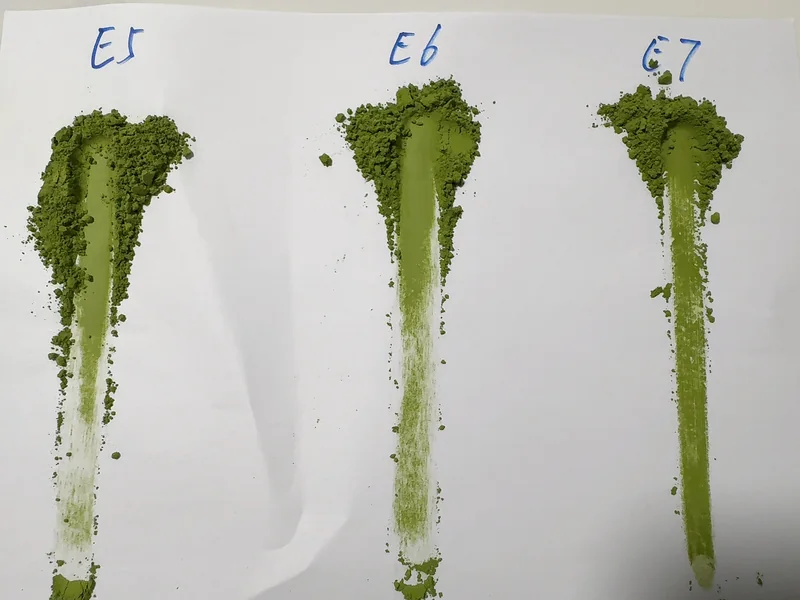
Matcha for crinkle cookies should meet a written target for baked color, flavor intensity, dispersion, and cost per finished cookie. The white coating makes uneven green color easy to see, so powder consistency matters beyond the mixing bowl.
Screen samples in the actual dough rather than judging dry powder alone. Record the same dose, flour lot, bake profile, and cooled-cookie lighting for every sample. A supplier sample can look vivid in a cup yet shift after exposure to fat, sugar, heat, and alkaline leavening.
The matcha powder for baking guide covers broader baking-grade selection. For this pilot, request a product specification and compare samples from an appropriate culinary matcha product range under the same cookie process.
Key Takeaway: Approve matcha by its cooled-cookie result and purchasing specification, not dry-powder color alone.
How should matcha crinkle-cookie dough be mixed for even color?
Matcha and flour for crinkle-cookie dough should be dispersed before final dough development, then mixed only until the dry blend is uniform. Sifting breaks visible powder clusters; dry blending distributes the fine particles across a much larger flour mass.
Add the blend consistently and define an endpoint that operators can recognize. Overmixing after flour addition can tighten the dough, while undermixing leaves dark matcha streaks and pale flour pockets. Track mixer type, batch load, speed, time, bowl scrape, and final dough temperature.
A practical line check is to cut several deposits from different bowl locations. Compare their color and texture before committing the batch to coating. If variation follows bowl position, fix dispersion or scraping before changing the matcha dose.
Key Takeaway: Standardize dry dispersion and the final mixing endpoint before adjusting color with more matcha.
Can matcha crinkle cookie dough run without chilling?
Matcha crinkle cookie dough can run without chilling when creaming, room temperature, fat plasticity, and deposit handling stay inside a proven window. A no-chill system saves queue time, but it transfers control work to the mixing room and depositing step.
One reviewed no-chill formula uses softened butter and immediate portioning. Other reviewed formulas use melted butter or oil and chill for at least one hour because their dough is softer or stickier. These examples support a two-route pilot, not a rule that all butter dough skips chilling or all oil dough requires it.
| Decision | Choose it when | Avoid it when | Operational consequence |
|---|---|---|---|
| Creamed-butter, no-chill pilot | Dough releases cleanly at normal room conditions | Deposit shape drifts during the batch | Faster flow, tighter temperature and aeration control |
| Chilled melted-fat or oil pilot | A defined hold creates stable portions | Cold storage or rewarming is uneven | Longer lead time, wider handling window |
My practical choice is no-chill only after first-to-last deposit tests show stable diameter and crackle. Otherwise, a timed chilled hold costs capacity but reduces handling surprises.
Key Takeaway: Treat no-chill as a verified process window, not a recipe label.
What crinkle-cookie piece weight and shape give a repeatable crackle?
A repeatable matcha crinkle-cookie crackle starts with a narrow piece-weight range and a consistent rounded shape. Large weight swings change heating time, spread, crack width, and the ratio of white coating to green surface.
Publisher examples range from small 30–35 g pieces to larger 60–65 g pieces, while other recipes describe 1.5-tablespoon or golf-ball portions. Use those only as source-informed pilot brackets. Set the commercial target from the required cookie diameter, pack count, and eating texture.
Weigh consecutive deposits, not handpicked ones. Then photograph cooled cookies over a diameter grid and note seams, flat spots, and coating loss. A depositor that hits weight but tears the surface may still produce irregular cracks.
Key Takeaway: Lock piece weight and surface shape together because both govern expansion and crack pattern.
Should matcha crinkle cookies use double or single coating?
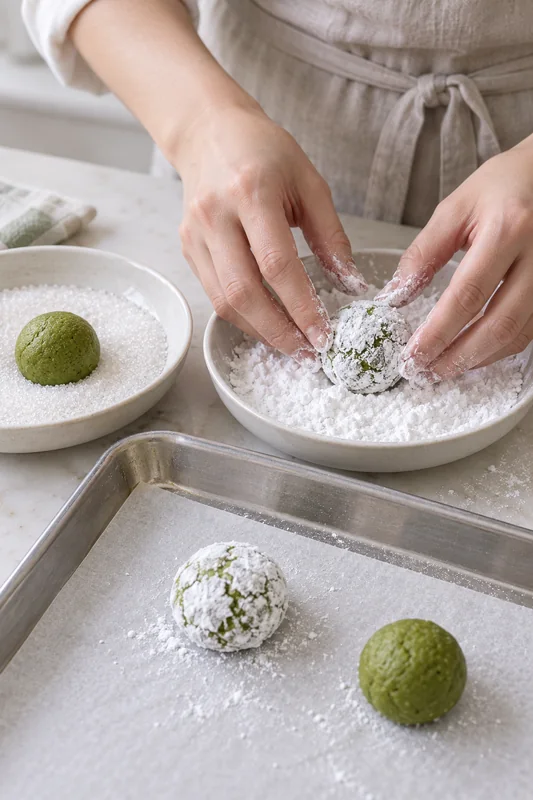
Matcha crinkle cookies should use double coating when a granulated-sugar barrier measurably protects powdered-sugar contrast through cooling and packing. A single powdered-sugar coat is simpler, but it needs its own melt-through and handling evidence.
Four reviewed recipes roll dough in granulated sugar before powdered sugar and describe the first layer as a moisture barrier. One reviewed kit recipe uses confectioners’ sugar alone. For a bakery, the choice should follow measured coating pickup, bare-spot rate, crack visibility, and post-pack abrasion.
| Coating route | Benefit to test | Cost or risk | Release check |
|---|---|---|---|
| Granulated then powdered | Stronger white-green contrast | Extra handling and sugar pickup | White coverage after cooling and packing |
| Powdered sugar only | Faster, simpler coating | Melt-through or bare spots | Contrast after the same hold and pack test |
I would start with double coating when shelf presentation depends on bright cracks. Use single coating only if the simpler step survives the same cooling and package test.
Key Takeaway: Compare coating systems after handling and packing; oven-exit appearance is too early to decide.
How should crinkle-cookie baking balance spread, cracks, and a soft center?
Crinkle-cookie baking should balance expansion and setting so the cookie opens the sugar shell without flattening or drying the center. Temperature, time, leavening, pan color, dough temperature, and piece weight all affect that balance.
Reviewed publisher examples run from 320°F to 350°F and commonly bake around 8–11 minutes. Those are source-informed pilot proposals, not commercial safety limits or validated AHM settings. Start with the formula developer’s range, then map diameter, height, crack coverage, center texture, and cooled color.
Raw flour can carry harmful bacteria, and raw eggs also require control. The FDA’s flour-handling guidance advises against eating raw dough and identifies cooking plus cross-contamination controls as necessary. Validate the bakery’s own process rather than using visible crackle as proof of safety.
Key Takeaway: Set the bake window from measured quality and a validated food-safety process, never from crackle alone.
How can tray position be checked across a matcha crinkle cookie batch?
Tray position should be checked by comparing the first, middle, and last production trays under the same measurement method. This reveals drift from oven zones, pan temperature, dough warming, coating delay, and load pattern.
Sample cookies from the front, center, and rear of each chosen tray. Record median diameter, height, color, crack coverage, and obvious bare spots after cooling. Keep pan type, liner, spacing, rack, and rotation practice in the record.
A single attractive tray can hide a weak process. If later trays spread more, examine dough temperature and queue time before changing leavening. If one oven zone browns faster, correct loading or airflow before changing the entire formula.
Key Takeaway: Release the process from a tray map across time and oven position, not a best-cookie photo.
When can matcha crinkle cookies be cooled and packed?
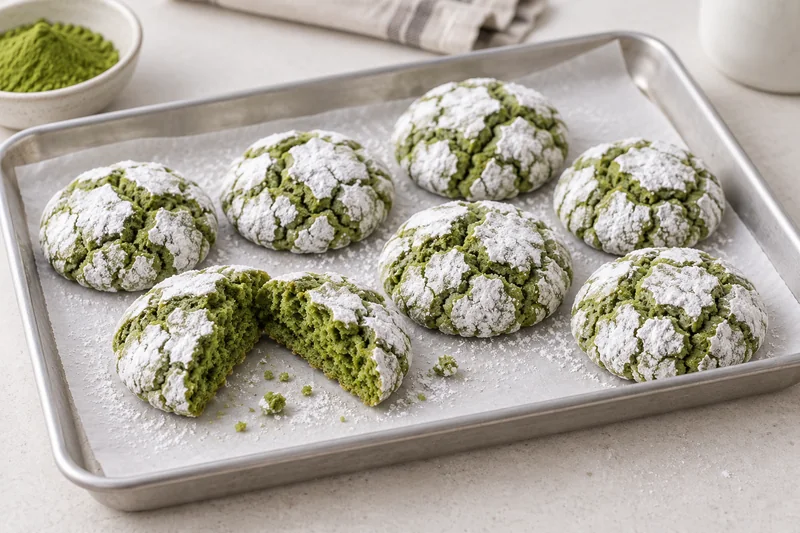
Matcha crinkle cookies can be packed when they are cool enough to avoid condensation and firm enough to resist coating abrasion. Packing too early traps moisture; rough transfer can erase the contrast even when baking was correct.
Define a cooling endpoint with observable evidence. Record cookie and room conditions, cooling time, surface tack, powdered-sugar loss, and pack-window appearance. Then run the intended tray, pouch, or carton through normal stacking and movement.
For adjacent baked applications and presentation ideas, the best matcha baking recipes guide gives a broader cluster view. Keep this cookie’s acceptance criteria specific to its crackled shell.
Key Takeaway: Approve packing only after cooling and handling preserve both structure and white-green contrast.
What should the final matcha crinkle cookie pilot record?
The final matcha crinkle cookie pilot should connect ingredient lots, process settings, and cooled results in one batch record. That record lets production and purchasing distinguish a powder issue from a mixing, holding, coating, or oven issue.
Record formula percentages, matcha lot, fat state, mixer load, dough temperature, hold time, piece weight, coating pickup, tray position, bake settings, yield, diameter, crackle score, color photos, sensory notes, and corrective action. Use fixed lighting and a labeled scale in photographs. If instruments are available, record their method and calibration rather than treating a color number as self-explanatory.
Approve a supplier specification only after repeated pilots meet the same limits. AdoroHu Matcha can review the intended application and sample requirements through the contact page.
Key Takeaway: A useful pilot record links every defect to a controllable material or process variable.
FAQ
- Why did the powdered sugar disappear on matcha crinkle cookies?
- Surface moisture, warm dough, light coating, or early packing can dissolve or absorb the sugar. Compare coating pickup and cooled appearance before changing several variables at once.
- Do matcha crinkle cookies always need chilling?
- No. Creamed-butter dough may support a controlled no-chill process, while melted-fat or oil systems often use a timed hold. Confirm the choice with deposit, spread, and crackle trials.
- Is culinary or ceremonial matcha better for crinkle cookies?
- Choose by baked color, flavor, dispersion, specification, and cost per finished cookie. A consistent culinary matcha may fit the application better than a higher-priced powder selected by label alone.
- Why are the cookies spreading without clear cracks?
- Check dough temperature, fat state, piece shape, coating coverage, leavening, and oven profile. Change one variable per trial so the cause remains visible.
- Can visible cracks confirm that the cookies are safely baked?
- No. Crackle is a quality cue, not a food-safety validation. Use the bakery’s validated cooking and cross-contamination controls for raw flour and egg ingredients.
- What should a bakery photograph during a pilot?
- Photograph raw coated pieces and cooled cookies from the first, middle, and last trays under fixed lighting, with a scale and batch label visible.
Conclusion
A stable matcha crinkle cookie line starts with a bounded pilot, not a borrowed bake time. Compare the two dough routes and both coating systems under the same piece-weight, tray, cooling, and package checks, then write the winning limits into the production and purchasing specifications.